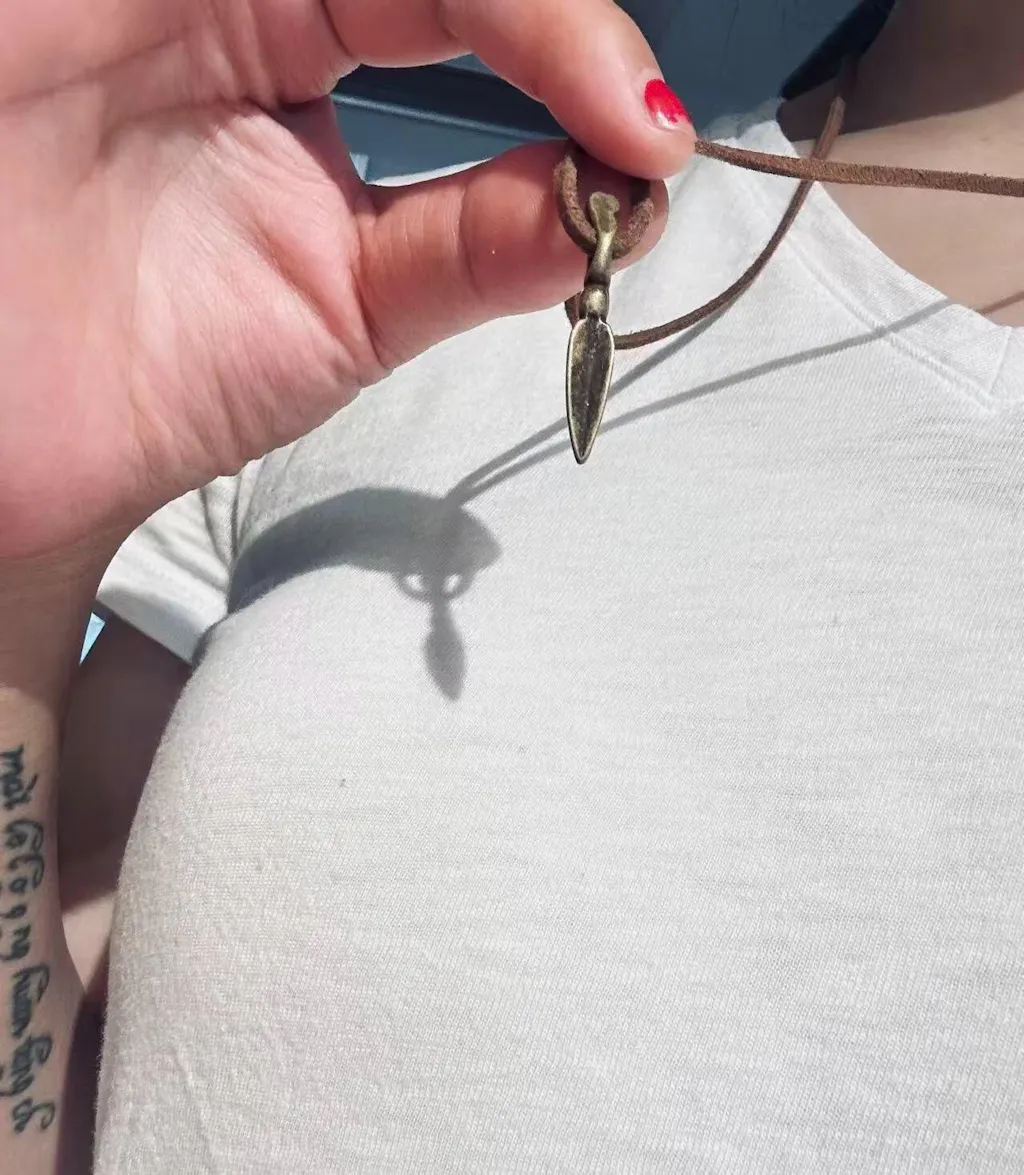
【Product Specifications】
| Attribute | Description |
|---|---|
| Material | Copper |
| Craftsmanship | Handmade |
| Ritual | 20 hours of traditional sutra and mantra chanting |
| Size | 33.1mm × 7.5mm |
| Weight | 2.5g |
| Packaging | Elegant gift box + cloth bag |
| Origin | Tibet, China |


Estimated Delivery:Sep 13 - Sep 17
Free Shipping & Returns: On all orders over $75

「Hayagriva Phurba」 Core Energies
♥ Destroying negative energy ♥ Subduing evil forces ♥ Powerful protection ♥ Subduing obstacles
About the Hayagriva Phurba
I started practicing magic and learning mantras when I was 7 years old. My goal was always simple — to help people solve real problems in their daily lives. Over the past 20 years, I've helped many people in China. But as a practitioner, I feel it's important to be upfront about a few things — I don't want to waste your time, and I don't want you to make an impulsive purchase.
1. About results: I won't promise you that wearing this will change your destiny, win you the lottery, make your illness disappear overnight, or bring love to your door right away. This is a supporting tool — not a magic wand. I use the power of ritual and mantras to help you move closer to where you truly want to be in life.
2. About imperfections: All of our Hayagriva Phurba pieces are carefully handcrafted by skilled artisans. As a result, slight variations in appearance are natural. If you're looking for flawless uniformity, there are plenty of beautiful synthetic alternatives out there.
3. About connection: Take a moment. Look at it. Sit with it. Trust your instinct — deep down, you already know what you need. If something feels off, or if you feel any resistance, please don't buy it. A piece of jewelry should bring you joy and support — if it becomes a mental burden, even for free, it's not worth it.
If any of this resonates with you, then please keep reading — I'd love to tell you more about it.
Exterior: Copper Hayagriva Phurba
Think of this copper Hayagriva Phurba as the "special forces" of spiritual tools — it's not here for pleasantries, it's here to get the job done.
1. Like a stapler that "nails down" evil forces
Hayagriva is a wrathful deity — quick to act and fierce in resolve. This Phurba is a "demon‑subduing nail." When faced with stubborn, clinging evil spirits or persistent bad luck that won't go away, it doesn't just push them aside — it drives them down, pins them in place, and makes them dissolve completely.
2. A sharp blade that cuts through emotional knots
If you're carrying pent‑up anger, holding onto obsessions, or feeling drained by toxic people and situations, this acts like a sharp knife — cleanly cutting through the tangled mess of emotions, giving you instant relief and freeing you from mental spirals.
3. A "stabilizing stake" for your energy field
Its shape is like a stake — once driven in, it stays put. Place it in your home or carry it with you, and it sets solid "foundation posts" in your energy field. Any chaotic winds or harmful energies trying to push through will hit them and scatter, keeping you well protected.
4. Made for "hard‑to‑crack" problems
This is not a gentle, passive protector. It's for emergencies and tough cases. If you're facing a dead‑end situation that won't budge, or feel like something dark has its eyes on you, this is your "game‑changer" — quick, powerful, and ready to flip the table and break you free.
This Phurba is the hardcore guardian that doesn't back down. It doesn't reason with obstacles — it simply nails them outside the door. With it, you carry an "all‑purpose counter" — confidence that you can handle whatever comes, and life becomes that much steadier. 😎

Chanting & Consecration Ritual
After each piece is crafted, it undergoes a 20‑hour consecration ritual, which takes 2–3 days to complete.
1. What is consecration?
Consecration means inviting a trained practitioner to perform a traditional ritual — including chanting sutras, reciting mantras, and empowering the object — in accordance with an established lineage. This is not "psychological suggestion," not "a symbolic gesture," and not just "making it feel nice."
It is a religious ceremony in the truest sense. Since we do it, we want to be honest about it — who did it, how it was done, and what was performed.
2. Who performs the ritual?
We invite a monk from a temple with a genuine lineage — a practitioner who has been devotedly cultivating for decades, not someone seeking fame online. He doesn't care about views or likes — he cares about precepts and integrity.
If the monk agrees, we name them on the product certificate. If not, we refer to them as "a monastic teacher we have supported for many years."
This is not a quick job done by a junior apprentice, nor is it a recording played on loop. It is done by a real person in a consecrated space, following authentic ritual protocols, one piece at a time.
3. How is it done?
It's much simpler and more grounded than what you might see in movies — no flashing lights, no dramatic theatrics.
It goes like this:
Cleaning and altar preparation: The space is cleansed, offerings are placed before the Buddha statue, and incense and lamps are lit.
Chanting and mantra recitation: The monk sits with ritual tools and recites sutras and mantras over your piece, one by one. This continues for 20 hours over 2–3 days — not just 30–50 minutes as a quick formality.
Blessing and empowerment: After the ceremony, the piece is no longer just an object — it carries the blessing and protection of the sutras and mantras.
We cannot film the entire process (some parts are not permitted to be recorded), but we do have photos of the ritual site. Feel free to ask our customer service team for them anytime.
4. What does consecration mean afterward?
We do not promise that "your life will change overnight." That would not be truthful — it would be boasting.
Here is how we understand it: it's like installing a permanent signal on your phone. That signal connects your confidence when wearing it, the blessings of the monk's practice, and the protective power of the lineage itself.
Let's talk about consecration openly.
Many people hear the word and immediately think, "Is that real?" — which is understandable. Too many people out there have exploited the term and ruined its reputation. "Master‑consecrated" pieces often turn out to be nothing more than mass‑produced items with stickers on them.
Here's what we actually do:
Step one: We invite a monastic teacher with an authentic lineage — not an internet influencer, but someone who has quietly practiced for decades. He cares about discipline, not fame.
Step two: Each batch is consecrated according to real ritual procedures — offering to the Buddha, chanting sutras, reciting mantras, empowering the pieces. Nothing is skipped.
Step three: After the ritual, these items are stored separately from regular inventory.
We won't say "guaranteed to work" — that would be dishonest. What we will say is: We really did it. That is a fact.
If you believe in it, let it be a spiritual support in your life. If not, that's okay too — we also offer a non‑consecrated version, which is equally beautiful.
Certification card included with shipment:
The pendant you receive has been consecrated.
Date: [Month Day, Year]
Location: [Temple/City Name]
Presiding Monk: [Name, or "a monk who has practiced in the [tradition] lineage for many years"]
From that day forward, it carries a blessing. Please treat it with care and respect. Take it off when bathing — not because the blessing will disappear, but as a basic sign of respect for the blessing it holds.
May you wear it with peace of mind and grounded confidence.
Core Mantras for the Hayagriva Phurba Pendant
Secret Purification Mantra
Secret Activation Mantra
Phurba Heart Mantra
Vajrakilaya (Phurba) Heart Mantra
Mahakala Heart Mantra
Yamantaka Heart Mantra
Vajra Armor Mantra
Obstacle‑Removing Mantra
Vajra Demon‑Subduing Mantra
Ten‑Sword Mantra
Four Weapons Mantra
Powerful Reflection (Deflection) Mantra
Pongmajia Mantra
Burmese "Grandma Ang" Exorcism & Spirit‑Driving Mantra
Phra Pirab (Demon‑Subduing) Mantra
Asura King Demon‑Subduing Mantra
Buddhist Mantra for Dispelling Negative Energy
Reflection (Deflection) Mantra
Destiny Elevation Mantra
We will include a card with the seed mantras, so you can recite them anytime at home to strengthen the connection between yourself and the Hayagriva Phurba.
Shipping cost is based on weight. Just add products to your cart and use the Shipping Calculator to see the shipping price.
We want you to be 100% satisfied with your purchase. Items can be returned or exchanged within 30 days of delivery.